
Desserts · Peruvian cuisine
Crema Volteada (Peruvian Flan) by Sandra Plevisani
- Total time1 h 20 min
- Servings25
- DifficultyEasy
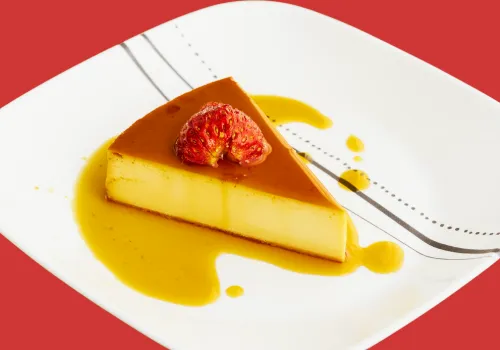
Crema volteada (Peruvian flan) is a classic of Peruvian baking, and Sandra Plevisani, a renowned chef and cookbook author, has perfected this recipe to delight every lover of traditional desserts. Plevisani's crema volteada is a smooth, delicate flan with a perfect balance of sweetness and texture, ideal for any occasion.
The base of this recipe is a simple but delicious mixture of eggs, evaporated milk, condensed milk and vanilla, blended until smooth. What sets Sandra Plevisani's crema volteada apart is her attention to detail when making the caramel, which is made by melting sugar in a pot over medium heat until it turns a deep golden color, without letting it burn and turn the dessert bitter. The caramel is poured straight into the mold where the custard will be baked, evenly coating the bottom.
The next step is to pour the custard mixture over the hardened caramel and bake it in a water bath (bain-marie), a method that guarantees gentle, even cooking and keeps the flan from cracking or drying out. Plevisani recommends baking the crema volteada at a moderate oven temperature, which gives the dessert a silky, light texture.
Once baked, the crema volteada must cool completely before being unmolded. When you turn the mold over, the caramel melts and forms a glossy, delicious layer that covers the flan, creating an irresistible contrast of flavors and textures.
Sandra Plevisani's crema volteada (profile in Spanish) is a dessert that brings back childhood memories and family traditions, with a flavor that never goes out of style. Perfect as a dessert at family gatherings or as a sweet treat for yourself, this classic of Peruvian baking shows Plevisani's skill at taking traditional recipes to another level. You can also make delicious cornstarch alfajores or try our brownie recipe (in Spanish); every one of our recipes is posted with love.
Did you like this recipe? ✨
Save it, share it or make it this weekend. And don't forget to subscribe for more authentic, easy Peruvian recipes!
If you have a restaurant or a huarique (a small, beloved local eatery) you would like to promote, take a look at our guide to Peruvian restaurants around the world (in Spanish), which we will be launching very soon.
Crema Volteada (Peruvian Flan) by Sandra Plevisani
- Prep time
- 20 min
- Cook time
- 1 h
- Total time
- 1 h 20 min
- Oven temperature
- 100 °C
- Servings
- 25
- Difficulty
- Easy
Best season: Summer
Ingredients for Sandra Plevisani's Crema Volteada
Caramel
Custard
How to Make Sandra Plevisani's Crema Volteada
Caramel
Put the sugar and water in a pot without stirring or moving it, and leave it over medium heat until you see it turn caramel-colored, then turn off the heat.
Pour all the caramel into a 27 cm round mold and, very carefully, spread it evenly over the whole inside of the mold. Set aside.
Custard
How to make a smooth custard for our crema volteada
In a bowl, mix the ingredients: eggs, condensed milk, evaporated milk and vanilla.
Use a sieve to remove any lumps from the egg; following Sandra's instructions, you should strain it 10 times until the mixture is perfectly smooth.
Pour the mixture into the mold.
Water bath for the crema volteada
Preheat the oven.
Prepare the dish for the water bath: place a cloth on the bottom of the dish, add water and set the crema volteada mold on top of the cloth.
Unmold
Once a toothpick inserted comes out clean, the crema is ready. Let it cool and then leave it in the refrigerator overnight. The next day, gently run a knife around all the edges and turn it out onto a deep plate, since the caramel will run. Enjoy!
Frequently Asked Questions about Peruvian Crema Volteada
What is the difference between crema volteada and flan?
Crema volteada and flan are very similar but have subtle differences. Traditional Peruvian crema volteada is denser, firmer and less jiggly, with a creamier, more compact texture because it uses more eggs (6–8 whole eggs per liter of milk). Spanish or Mexican flan is softer, jigglier and more delicate, with fewer eggs and sometimes gelatin. Crema volteada is baked in a water bath directly in the caramel-lined mold, while some flans are cooked on the stovetop. The flavor is practically the same: sweet, with caramel and vanilla. In Peru we say “crema volteada”; in other countries, “flan”. Both are delicious desserts topped with liquid caramel.
Why does my crema volteada have holes?
Holes or bubbles in crema volteada happen when the mixture has too much air or the oven was too hot. To avoid them: 1) whisk the eggs gently; don't use an electric mixer, which adds a lot of air. 2) Mix with folding movements, not vigorously. 3) Strain the mixture before pouring it into the mold to remove bubbles. 4) Let it rest for 5 minutes and skim the bubbles off the surface with a spoon. 5) Bake at a low temperature (150–160 °C) in a water bath with hot water reaching halfway up the mold. 6) Don't open the oven while it bakes. A perfect crema volteada should have a smooth, creamy texture with no air pockets.
How long should crema volteada bake?
Crema volteada bakes in a water bath at 160 °C for 50–70 minutes, depending on the size of the mold. An individual mold (6–8 oz) takes 35–45 minutes. A medium mold (1 liter) takes 60–70 minutes. A large mold (1.5–2 liters) can take up to 90 minutes. The crema is ready when the center still wobbles slightly when you gently move the mold but is no longer liquid. There should be no bubbles at the edges. A toothpick inserted near the edge should come out clean, but the center can be slightly moist (it finishes cooking with the residual heat). If you overbake it, it will have a scrambled-egg texture and the surface will crack. Let it cool and refrigerate for at least 4 hours.
Can crema volteada be made without a water bath?
Technically you can bake crema volteada without a water bath, but you risk a lumpy texture, cracks or uneven cooking. The water bath provides gentle, moist heat that cooks the custard evenly. If you don't have a large enough tray for a water bath, you can: 1) bake at a VERY low temperature (140 °C); it will work but take longer. 2) Cook it in a pressure cooker: 15 minutes at high pressure (excellent results). 3) Steam it in an electric rice cooker lined with parchment paper (40–50 minutes). 4) Use a slow cooker on LOW for 2–3 hours. But if you want the perfectly smooth, creamy texture, the traditional oven water bath is unbeatable.
Why is my crema volteada caramel too hard?
Caramel turns too hard when it is overcooked or when it crystallizes. For a perfect liquid caramel: 1) use refined white sugar (not brown sugar or panela). 2) Add 2–3 tablespoons of water to the sugar at the start to control the cooking. 3) Cook over medium heat, not high. 4) DON'T stir; just swirl the pan. 5) Cook until it is a medium amber color (not too dark, or it will be bitter and hard). 6) Add a few drops of lime juice or vinegar to prevent crystallization. 7) Immediately pour it into the mold and tilt it to coat the bottom and sides. The caramel hardens as it cools, but it should melt completely when you turn out the custard after baking. If it is still too hard, warm the mold slightly before turning it out.
How long does crema volteada keep in the refrigerator?
Homemade crema volteada keeps for 3–5 days in the refrigerator, well covered with plastic wrap or in an airtight container. It must always be kept refrigerated because it contains eggs and milk. The liquid caramel stays perfect during that time. Freezing is not recommended because the texture is ruined when it thaws (the water separates and it turns lumpy). For the best flavor, crema volteada is ideal after resting in the refrigerator for at least 6–8 hours, or better overnight, which lets the flavors blend and the texture set perfectly. Serve it well chilled, straight from the refrigerator. If it smells sour or you see mold, throw it away immediately.